
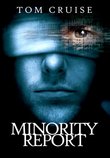
-
Trust Weighted
Good
-
66Trust Points
Wick's Review
Summary - Good 3.0
Just a decade old, Minority Report hasn’t aged well. Perhaps because it’s based on a short story from the Fifties?
Some of its vaunted futuristic technologies now seem ridiculous. To wit, newspapers with live displays are delivered daily to the front lawn. Why?
Reality factor quibbling aside, the movie is beset by four larger problems. Stephen Spielberg made a nearly two-and-a-half hour movie from a short story, with motivations that are hard to accept, yet too obvious for a mystery. Thus a too long movie has a drawn-out plot both tortured and transparent.
Big quibbling aside, Minority Report has much to recommend it, including a solid moviestar turn by Tom Cruise, some intriguing technology forecasts and a plot that ultimately coheres.
Cruise fans and Philip K. Dickheads won’t be disappointed, though they’ve most likely seen it already.
Acting - Good 3.0
Tom Cruise plays roles like Minority Report’s conflicted police detective in his sleep. He plays it well.
His costars, not so much.
Max von Sydow, Steve Harris and Colin Farrell are more than adequate if not nearly scintillating.
The secondary characters generally fare better.
- Peter Stormare plays an especially slimy back-alley doctor.
- Neal McDonough is an always welcome presence, square-jawed and blond, yet down to earth.
- Lois Smith too is a wonderfully grounded presence.
- Tim Blake Nelson is reliably freaky.
- Arye Gross is reliably unsympathetic.
- Mike Binder plays against type as a serious sociopath.
- Samantha Morton is just this side of ridiculous as a mutant savant.
Male Stars - Very Good 3.5
Female Stars - OK 2.5
Female Costars - Good 3.0
Male Costars - Good 3.0
Film - Good 3.0
The film is most remembered for its futuristic technologies, such as newspapers that are live displays. More impressive are the live billboards that literally speak in familiar terms to passersby, as in “Hey Wick, aren’t you hungry for some hamachi?”
Direction - Very Good 3.5
Dialogue - Good 3.0
The story speaks - poorly - to our capacity for free will and the terror of an overbearing police state.Music - Good 3.0
Visuals - Very Good 3.5
Edge - Risqué 1.9
Sex Titillating 1.6
Violence Fierce 2.1
Rudeness Salty 2.1
Reality - Supernatural 3.2
Never mind the physical and biological reality liberties. Those are plenty acceptable for a SciFi movie.
The circoreality loopholes darn near ruin the movie however. To wit, we’re asked to believe that in a future police state that is omnisciently monitored, a disgraced cop’s access privileges wouldn’t be revoked by automated security systems. Ridiculous.